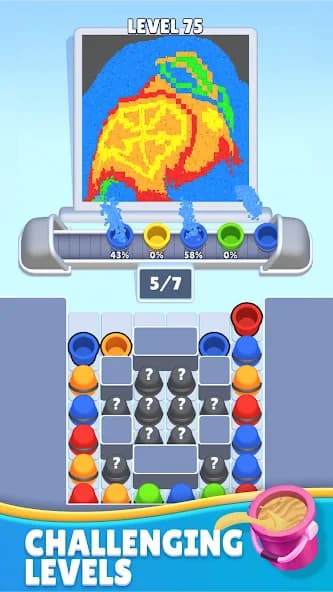
Welcome to the advanced tier of Sand Loop mastery! If you've made it past level 100, you've already demonstrated solid understanding of the game's mechanics. Now it's time to refine your skills and learn the expert strategies that separate good players from great ones.
The Expert Mindset: Thinking Beyond Basics
Advanced Sand Loop levels aren't just harder versions of early puzzles - they require a fundamentally different approach. Expert players don't just react to what they see; they predict, plan, and execute with surgical precision.
Pattern Recognition at Speed: At this level, you should recognize patterns instantly. Train your brain to identify color sequences, belt rhythms, and optimal tap points within 2-3 seconds of starting a level.
Multi-Step Planning: While beginners plan one tap at a time, experts plan entire sequences. Visualize your next 5-7 taps before making the first move. This mental rehearsal dramatically improves accuracy.
Mastering Complex Color Patterns
Levels 100+ introduce intricate color combinations that can overwhelm even experienced players. Here's how to handle them:
Color Flow Mapping: Before starting, trace each color's path from source to destination. Identify where colors might interfere with each other and plan your timing to avoid mixing.
Priority Color Systems: In levels with 4+ colors, establish a priority order. Usually, you should collect colors that appear less frequently first, as they're easier to isolate. Save dominant colors for last when you can fill remaining spaces.
The Isolation Technique: Some colors are easier to collect when isolated from others. Create temporary "barriers" using already-collected sand to guide specific colors exactly where you need them.
Advanced Timing Techniques
Precision timing separates three-star performances from mediocre completions. Master these advanced timing concepts:
Belt Speed Multiplication: When multiple belts run at different speeds, calculate their speed ratios. If one belt moves twice as fast as another, you need to tap the faster belt more frequently. Practice makes this calculation instinctive.
Predictive Tapping: Instead of reacting to what you see, predict where colors will be 1-2 seconds in the future. This is especially crucial in fast-paced levels where reaction time creates delays.
Micro-Adjustments: Expert players make tiny tap adjustments - pressing slightly left or right of the optimal point, or holding for fractional seconds longer. These micro-adjustments fine-tune sand flow for pixel-perfect results.
Physics Exploitation: Using the Game Engine to Your Advantage
Understanding Sand Loop's physics engine allows you to perform techniques that seem impossible:
The Splash Redirect: When sand hits a surface at an angle, it splashes in predictable directions. Use this to redirect sand around obstacles or into hard-to-reach areas.
Pressure Building: Releasing large amounts of sand creates pressure that can push existing sand into new positions. This technique helps fill corners and eliminate air pockets.
Flow Control via Blocking: Sometimes you need to temporarily block sand flow to build up a larger amount before release. Identify natural blocking points in level geometry and use them strategically.
Efficiency Optimization for Three-Star Ratings
Getting three stars on advanced levels requires perfect efficiency. Here's how to optimize every aspect:
Tap Economy: Every unnecessary tap wastes time and sand. Plan routes that use the minimum number of taps. Expert runs often use 30-40% fewer taps than casual completions.
No-Waste Philosophy: Every grain of sand should serve a purpose. Avoid spilling, mixing, or releasing sand that doesn't contribute to the final pattern. Zero waste is the mark of a master.
Speed-Accuracy Balance: Fast completion is important, but not at the cost of accuracy. Find your optimal speed - fast enough for time bonuses, controlled enough to avoid errors.
Handling Multi-Stage Levels
Advanced levels often have multiple stages that must be completed in sequence:
Stage Transitions: Plan transitions between stages carefully. The sand configuration at the end of stage one affects stage two. Leave yourself in the best possible position for the next challenge.
Resource Management: Some levels have limited sand quantities. Calculate exactly how much sand you need for each stage and don't waste any on the early stages.
Checkpoint Strategy: If a level has checkpoints, treat each section as a separate mini-puzzle. Perfect each section individually before attempting a full run.
Mental Game and Focus Techniques
Expert-level play demands peak mental performance:
Flow State Achievement: Practice entering "the zone" where your hands move instinctively. This flow state comes from repetition and deep familiarity with game mechanics.
Failure Analysis: Don't just retry - analyze. After each failed attempt, identify the specific moment where things went wrong and devise a solution before trying again.
Session Structure: Tackle the hardest levels when you're most alert. Save easier three-star hunting for times when you're less focused. Quality practice beats quantity.
Advanced Power-Up Usage
At expert levels, power-ups aren't crutches - they're tools for perfection:
Strategic Slow Motion: Use slow-mo not for easy parts, but for the single most critical moment in a level. That one perfect tap can be worth an entire power-up.
Hint Deconstruction: When you use a hint, don't just follow it - understand why it works. Break down the hint's strategy and apply the underlying principle to similar situations.
Pattern Library: Common Advanced Configurations
Expert players build a mental library of common patterns:
The Spiral Fill: Levels requiring spiral patterns need outside-to-inside or inside-to-outside approaches. Recognize which variant you're facing instantly.
Layered Construction: Some levels require building in layers - bottom to top or top to bottom. Identify the correct layer order before starting.
Symmetric Challenges: Symmetric levels often have symmetric solutions, but not always. Determine whether to fill symmetrically or asymmetrically based on belt configuration.
Training Regimen for Continuous Improvement
Even experts need deliberate practice:
• Replay levels 50-75 on speed runs to maintain fundamental skills
• Practice specific techniques in isolation (timing drills, color separation exercises)
• Challenge yourself to three-star levels using fewer taps than your previous best
• Watch replays of your successful runs to identify improvable moments
The Path to Level 134 and Beyond
The final levels of Sand Loop test everything you've learned. Approach them with patience, persistence, and the knowledge that every expert struggled with these challenges too.
Remember: expert status isn't about never failing - it's about learning faster, adapting quicker, and executing with precision. Every failed attempt adds to your experience. Every perfect level reinforces good habits.
Keep pushing your limits, stay patient with difficult levels, and celebrate small victories. The satisfaction of three-starring a level that once seemed impossible is what makes Sand Loop's advanced gameplay so rewarding.
Now take these strategies, apply them consistently, and watch your expert-level gameplay reach new heights!
