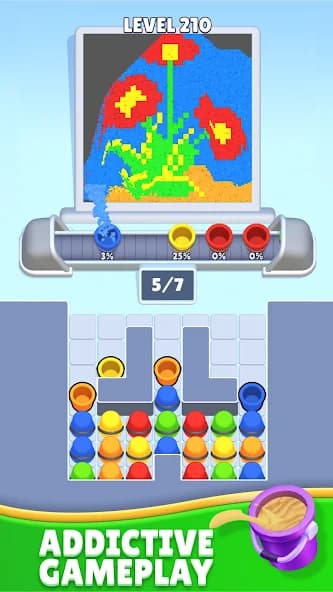
What makes Sand Loop so incredibly satisfying to play? The answer lies in its sophisticated physics engine that simulates realistic sand behavior. But beyond the technical wizardry, there's real science behind why watching sand flow triggers our brains' reward centers and keeps us coming back for "just one more level."
The Psychology of Satisfying Physics
Sand Loop taps into fundamental human responses to certain types of motion and interaction:
ASMR and Visual Satisfaction: Watching sand flow triggers similar neural responses to ASMR videos. The smooth, predictable-yet-organic movement creates a calming effect that reduces stress while maintaining engagement.
Control and Mastery: The physics engine is deterministic - the same action produces the same result. This consistency allows skill development, creating the satisfying feeling of mastery as you improve.
Immediate Feedback: Physics simulation provides instant visual feedback for every action. Your brain processes this feedback faster than conscious thought, creating an intuitive connection between input and result.
Understanding Particle Behavior
Sand Loop simulates individual sand grains (particles) that follow real-world physics rules:
Gravity and Acceleration: Particles accelerate downward at a constant rate (simulated gravity). This creates natural falling patterns that match your intuitive expectations from real-world experience.
Collision Detection: When particles hit surfaces or each other, they respond realistically - bouncing slightly, transferring momentum, and settling into stable configurations. This complexity happens in milliseconds, processed by the physics engine.
Friction and Drag: Particles don't slide forever - friction slows them until they stop. Air resistance (drag) affects falling particles. These subtle forces create realistic behavior without chaotic randomness.
Flow Dynamics: Why Sand Behaves Like Liquid
Sand exhibits fascinating properties that blur the line between solid and liquid:
Granular Flow: Large groups of sand particles flow like liquid around obstacles and through openings. Sand Loop accurately simulates this "granular flow" behavior, making sand feel alive and responsive.
Angle of Repose: Sand naturally forms slopes at specific angles (about 30-35 degrees). The game respects this physics principle - sand won't form impossible vertical walls or unrealistic flat surfaces.
Jamming and Clogging: Narrow openings can cause sand to jam, just like in reality. The game uses this phenomenon in puzzle design - sometimes you need to prevent jams, other times you need to create them strategically.
Color Mixing and Separation
One of Sand Loop's cleverest mechanics is how it handles colored sand:
Particle-Level Color: Each particle carries a color value. When differently colored particles mix, they don't blend into a new color - they remain distinct particles that intermingle. This matches real sand behavior.
Layering Effects: When you pour one color on another, physics naturally creates layers. Understanding this helps predict outcomes - you can create intentional layers or avoid unintentional mixing.
Separation Challenges: Once colors mix, they're extremely difficult to separate - just like real sand. This creates interesting puzzles where preventing mixing is crucial.
The Math Behind Beautiful Patterns
Sand Loop's stunning visual patterns emerge from mathematical principles:
Symmetry and Balance: Successful solutions often create symmetric patterns because physics favors balanced states. Gravity naturally distributes particles evenly when given symmetric starting conditions.
Fractal-Like Structures: Some levels create self-similar patterns at different scales - a fractal property. These emerge naturally from particle physics without special programming.
Optimal Packing: When sand settles, particles find positions that minimize empty space. This "optimal packing" creates satisfying, complete-looking patterns at the end of levels.
Timing, Momentum, and Prediction
Advanced play requires understanding physics-based timing:
Fall Time Calculation: Experienced players intuitively calculate how long particles take to fall from release point to target. This involves distance, gravity, and initial velocity.
Momentum Transfer: When falling sand hits existing sand, it transfers momentum, causing shifting and settling. Predict this secondary movement to position particles precisely.
Stream Cohesion: Sand released in quick succession forms a cohesive stream with predictable properties. Understanding stream behavior versus individual particle behavior elevates your gameplay.
The Conveyor Belt System: Moving Physics
Conveyor belts add complexity to the physics simulation:
Relative Velocity: Particles on a moving belt have velocity from both the belt and their own movement. Your brain must calculate combined velocities to predict landing positions.
Transfer Points: When particles leave a belt, they retain the belt's velocity initially, then transition to pure gravitational fall. This transfer point creates crucial timing windows.
Multiple Belt Interactions: Levels with multiple belts create complex velocity combinations. Mastery involves tracking multiple moving reference frames simultaneously.
Why Realistic Physics Makes Better Puzzles
Sand Loop could have used simplified physics, but realistic simulation creates superior gameplay:
Skill Transfer: Because the physics matches reality, your real-world intuition applies. You don't need to learn arbitrary rules - your brain already knows how sand "should" behave.
Emergent Complexity: Complex behaviors emerge naturally from simple physics rules. Designers don't need to script every interaction - physics creates variety automatically.
Fair Consistency: Realistic physics is perfectly consistent. Failure always results from player error, never from random or unfair game behavior. This consistency is crucial for puzzle integrity.
The Cognitive Benefits of Physics-Based Puzzles
Playing Sand Loop provides genuine cognitive benefits:
Spatial Reasoning: Predicting three-dimensional particle movement enhances spatial intelligence. You're constantly rotating mental models and projecting trajectories.
Cause-Effect Understanding: The immediate, consistent feedback strengthens your brain's ability to predict outcomes from actions - a fundamental cognitive skill.
Planning and Execution: You develop executive function by planning move sequences and executing them precisely. This transfers to real-world planning abilities.
Stress Relief Through Predictability: Unlike chaotic games, Sand Loop's physics creates a predictable, controllable environment. This predictability is genuinely relaxing while remaining engaging.
Technical Marvels Behind the Scenes
Appreciate the engineering that makes smooth gameplay possible:
Real-Time Simulation: The game calculates thousands of particle interactions per second while maintaining smooth 60fps performance. This requires optimized algorithms and efficient coding.
Collision Optimization: Checking every particle against every other particle would be computationally impossible. The engine uses spatial partitioning and other optimizations to make it work.
Visual Rendering: Transforming physics data into beautiful graphics happens in milliseconds. The rendering pipeline blends particle positions, colors, and lighting for stunning results.
Learning from Physics to Improve Gameplay
Apply physics knowledge directly to better performance:
• Predict fall times using mental distance estimation
• Anticipate momentum transfer when sand lands on sand
• Use angle of repose to judge if slopes will hold or collapse
• Calculate stream width based on release duration
• Predict mixing patterns based on flow velocities
The Beauty of Simulated Reality
Sand Loop proves that realistic physics isn't just about accuracy - it's about creating deeply satisfying, intuitive gameplay. The next time you play, take a moment to appreciate the invisible complexity making every tap feel perfect.
Understanding the physics doesn't reduce the magic - it deepens appreciation for both the natural laws being simulated and the engineering achievement of simulating them so seamlessly. Every flowing grain, every perfect color separation, every satisfying level completion is a small triumph of physics simulation.
Now return to the game with new understanding. Watch how particles accelerate, observe momentum transfer, appreciate the realistic flow dynamics. The physics was always there - now you see the beautiful science behind the addiction!