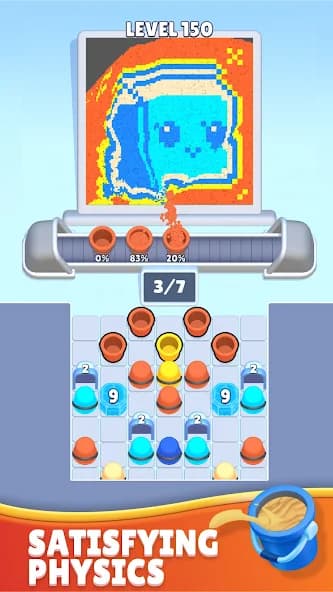
Have you ever wondered why some Sand Loop levels feel perfectly balanced while others present unique challenges that stick in your memory? The answer lies in meticulous level design that balances challenge, satisfaction, and visual appeal. Let's pull back the curtain and explore the craftsmanship behind your favorite puzzle game.
The Philosophy of Progressive Difficulty
Sand Loop's brilliance lies in its difficulty curve. The first 10 levels aren't just tutorials - they're carefully crafted introductions to fundamental concepts that will combine in complex ways later.
Concept Introduction: Each early level introduces exactly one new concept. Level 1 teaches basic tapping. Level 2 adds timing. Level 3 introduces color awareness. This granular approach ensures players never feel overwhelmed.
Mastery Through Repetition: Notice how levels 5-10 repeat earlier concepts with slight variations? This reinforces learning without feeling repetitive. Each variation adds a small twist that deepens understanding.
The Art of Visual Communication
Great level design communicates wordlessly. Sand Loop excels at teaching through visual cues rather than text:
Color as Language: Colors aren't just aesthetic choices - they guide player attention. Bright, saturated colors draw the eye to important elements. Muted backgrounds prevent distraction. This visual hierarchy helps players instantly identify what matters.
Movement and Direction: Watch how sand flows, belts move, and arrows point. These animations aren't decoration - they're instructions. The game teaches you where to tap by showing you where things naturally flow.
Spatial Design: Container shapes aren't random. Wide containers encourage bold tapping, while narrow tubes demand precision. The physical space itself teaches the required technique.
Balancing Challenge and Satisfaction
Every level walks a tightrope between too easy (boring) and too hard (frustrating). Here's how designers achieve perfect balance:
The Three-Attempt Philosophy: Well-designed levels should be completable in 1-3 attempts for players at the appropriate skill level. First attempt teaches, second refines, third perfects. This creates satisfying "aha!" moments without excessive frustration.
Multiple Solution Paths: Notice how some levels can be solved different ways? This isn't accidental. Multiple valid approaches respect player creativity while maintaining core challenge.
Difficulty Spikes and Valleys: The game doesn't get progressively harder in a straight line. Hard levels alternate with easier ones, creating rhythm. This prevents burnout and gives players regular confidence boosts.
The Psychology of Color Combinations
Color selection in Sand Loop follows psychological principles:
Complementary Challenges: Levels using complementary colors (blue-orange, red-green) create visual tension that increases perceived difficulty, even when mechanics are simple. This makes victories feel more impressive.
Analogous Ease: Levels with analogous colors (blue-green-teal) feel calmer and more approachable. Designers use these for levels introducing complex new mechanics, reducing overall stress.
Rainbow Complexity: Multi-color levels (4+ colors) represent the pinnacle of difficulty. The sheer variety creates both visual chaos and cognitive load, demanding peak player performance.
Architectural Elements: Building Memorable Levels
Certain levels stand out in memory because of distinctive architectural elements:
Signature Shapes: Spiral levels, pyramid constructions, and symmetric patterns create iconic moments. These "boss levels" punctuate progression with memorable challenges.
Obstacle Integration: Barriers, moving parts, and changing geometry keep gameplay fresh. Each obstacle type follows consistent rules, allowing players to develop transferable skills.
Negative Space: Empty areas are as important as filled ones. Strategic gaps force precision and create visual breathing room that prevents overwhelm.
Timing and Rhythm in Level Flow
Great levels have rhythm - a musical quality to successful completion:
Beat-Based Belts: Conveyor speeds often align with implicit beats. Successful players naturally tap in rhythm, creating a meditative flow state. This isn't coincidence - it's deliberate design.
Crescendo Structures: Many levels build intensity. They start slow, accelerate in the middle, then either maintain tension or resolve with a satisfying final tap. This narrative arc creates emotional engagement.
Pause Points: Well-designed levels include natural pause points where players can breathe and plan. These prevent the game from feeling overwhelming while maintaining challenge.
The Science of Sand Physics
Sand Loop's physics simulation isn't just realistic - it's tuned for gameplay:
Predictable Unpredictability: Sand flows realistically but within bounded parameters. Particles spread randomly but within predictable ranges. This creates natural behavior while preventing chaotic randomness that would frustrate puzzle-solving.
Satisfying Feedback: The weight, flow rate, and collision responses are tuned for maximum satisfaction. Sand feels substantial and responsive, making every tap rewarding regardless of outcome.
Visual Clarity: Despite realistic physics, sand never becomes so chaotic that players can't track individual colors. This clarity-first approach ensures physics serves gameplay, not the reverse.
Tutorial Integration: Teaching Without Teaching
Sand Loop rarely pauses for tutorials, yet players learn complex systems effortlessly:
Contextual Introduction: New mechanics appear in simplified contexts. Multi-belt systems debut in levels with only two colors. Fast speeds start with generous margins for error. Context makes learning natural.
Immediate Feedback: The game shows you instantly whether you succeeded or failed, and why. Visual feedback (color mixing, overflow) teaches cause and effect without words.
Optional Mastery: Three-star ratings let players proceed without perfection, then return later for optional mastery. This respects different play styles and skill levels.
Designing for Replayability
Why do players return to completed levels? Intentional design choices create lasting appeal:
Optimization Challenges: Even after completion, levels offer optimization opportunities. Can you use fewer taps? Finish faster? This transforms puzzles into speedrun challenges.
Aesthetic Appreciation: Successful completions create beautiful patterns. The visual payoff makes replaying artistically rewarding, not just mechanically.
Skill Showcases: Certain levels become community favorites for demonstrating mastery. These "showcase" levels feature in player discussions and social sharing.
Common Design Patterns Across Levels
Recognizing these patterns helps you anticipate challenges:
• Layer Cake: Horizontal layers requiring bottom-up or top-down filling
• Spiral Galaxy: Circular patterns filled from center or edge
• Color Burst: Rapid color changes requiring quick mental switching
• Precision Path: Narrow channels demanding perfect aim
• Capacity Challenge: Limited container space requiring exact amounts
The Future of Sand Loop Design
As you master current levels, appreciate the craftsmanship behind each puzzle. Understanding design principles won't diminish your enjoyment - it will deepen appreciation for the careful balance of challenge, satisfaction, and beauty.
Every color choice, timing window, and spatial arrangement serves a purpose. Every level is a small masterpiece of interactive design. The next time you complete a particularly satisfying level, take a moment to admire not just your skill, but the invisible architecture that made your success possible.
Now, armed with insight into level design, return to your favorite puzzles and see them with new eyes. The craftsmanship was always there - now you can truly appreciate it!
